
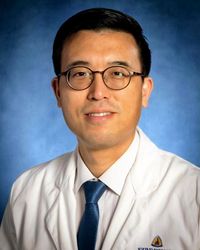
Sung-Min Cho, DO, MHS
Neurocritical Care
Highlights
Johns Hopkins Affiliations:
- Johns Hopkins School of Medicine Faculty
About
Professional Titles
- Director of Adult ECMO (Extracorporeal Membrane Oxygenation) Research
Primary Academic Title
Associate Professor of Neurology
Johns Hopkins Physician

Background
Dr. Sung-Min Cho is an Associate Professor of Neurology, Anesthesiology and Critical Care Medicine, and Surgery at the Johns Hopkins University School of Medicine. He is an attending neurointensivist in the Johns Hopkins Neuroscience Critical Care Unit and serves as Director of Adult ECMO Research at The Johns Hopkins Hospital.
Clinical Expertise
Dr. Cho specializes in the care of critically ill patients with acute neurologic and systemic illnesses affecting the brain. His clinical expertise encompasses neurocritical care, cerebrovascular disease, cardiac arrest and post-cardiac arrest brain injury, disorders of consciousness, and neurologic complications of cardiovascular disease and advanced life-support therapies. He cares for patients with ischemic stroke, intracerebral and subarachnoid hemorrhage, status epilepticus, severe encephalopathy, and other forms of acute brain injury requiring intensive neurologic monitoring and treatment.
A major area of his clinical expertise is the intersection of the brain, heart, and critical illness. Dr. Cho has particular expertise in neurologic complications associated with extracorporeal membrane oxygenation (ECMO), extracorporeal cardiopulmonary resuscitation (ECPR), left ventricular assist devices (LVADs), cardiac surgery, heart and lung transplantation, and other forms of mechanical circulatory support. His work addresses complex clinical problems such as stroke, intracranial hemorrhage, cerebral hypoperfusion, hypoxic-ischemic brain injury, seizures, coma, and determination of death by neurologic criteria in patients receiving advanced cardiopulmonary support.
Research
Dr. Cho leads a multidisciplinary research program focused broadly on understanding, detecting, predicting, and ultimately preventing acute brain injury in critically ill patients. His research spans clinical neuroscience, cardiovascular and critical care medicine, biomedical engineering, neurotechnology, and translational science.
A major focus of his laboratory is ECMO neuroscience, an emerging field examining how extracorporeal life support and severe cardiopulmonary failure affect the brain. His work has investigated the epidemiology and mechanisms of ischemic and hemorrhagic stroke during ECMO, cerebral blood flow and autoregulation, oxygen and carbon dioxide physiology, pulse pressure and cerebral perfusion, microembolic injury, electrophysiologic abnormalities, neuroimaging, and neurologic outcomes. He also studies strategies for earlier detection of otherwise clinically silent brain injury using multimodal neuromonitoring, including continuous EEG, near-infrared spectroscopy, transcranial Doppler ultrasonography, portable low-field MRI, physiologic waveform analysis, and blood-based biomarkers.
His research extends beyond ECMO to the broader interaction between the cardiovascular system and the brain. This includes neurologic injury associated with LVADs and other mechanical circulatory support devices, cardiac surgery, cardiac arrest and ECPR, transplantation, and infective endocarditis. He has also conducted research in ischemic stroke, intracerebral hemorrhage, subarachnoid hemorrhage, cerebral small-vessel and microvascular injury, and long-term neurologic and neurocognitive recovery following critical illness.
Another growing area of Dr. Cho's research is the development of technologies for monitoring and modulating brain function in critically ill patients. His interdisciplinary collaborations integrate electrophysiology, cerebral hemodynamics, wearable sensors, ultrasound and photoacoustic technologies, neuroimaging, circulating biomarkers, and computational approaches to characterize brain function and brain-body interactions. His translational work also explores neuromodulation and physiologic approaches to restoring brain network function following cardiac arrest, coma, and other severe acute brain injuries.
Across these areas, Dr. Cho's research seeks to bridge bedside neurocritical care with engineering and data science. By combining high-resolution physiologic data with imaging, biomarkers, and clinical outcomes, his program aims to develop individualized approaches for identifying patients at risk for neurologic injury, understanding potentially modifiable mechanisms of injury, and developing new monitoring and therapeutic strategies for patients in whom conventional neurologic assessment is often limited.
Education and Training
Dr. Cho began his undergraduate studies in physics at Yonsei University in Seoul, South Korea, and earned his Bachelor of Science degree from the University of Cincinnati. He received his medical degree from Ohio University and completed his internship and neurology residency at Cleveland Clinic. He subsequently completed a fellowship in neurocritical care at Johns Hopkins before joining the Johns Hopkins faculty in 2019. He also earned a Master of Health Science degree from the Johns Hopkins Bloomberg School of Public Health.
Centers and Institutes
Johns Hopkins Division of Neuroscience Critical Care
HERALD (Hopkins Education, Research, and Advancement in Life Support Devices) Program
Find a Clinical Trial
View all trials by this principal investigator.
Recent News Articles and Media Coverage
Additional Academic Titles
Associate Professor of Anesthesiology and Critical Care Medicine, Associate Professor of Cardiac Surgery, Associate Professor of Neurological Surgery
Research Summary
- PI: Hopkins Education and Research for the Advancement of Life support Devices (The HERALD Lab)
Google Scholar - Publications
PubMed - Publications
Pure - Research Profile
Research Gate - Research Profile
Selected Publications
-
Cho SM, Canner J, Chiarini G, Calligy K, Caturegli G, Rycus P, Barbaro R, Tonna J, Lorusso R, Kilic A, Choi CW, Ziai W, Geocadin R, Whitman G. Modifiable Risk factors and mortality from ischemic and hemorrhagic strokes in patients receiving veno-arterial extracorporeal membrane oxygenation: Results from the Extracorporeal Life Support Organization Registry. Critical Care Medicine. 2020
-
Cho SM, Hwang J, Chiarini G, Amer M, Antonini MV, Barrett N, Belohlavek J, Brodie D, Dalton HJ, Diaz R, Elhazmi A, Tahsili-Fahadan P, Fanning J, Fraser J, Hoskote A, Jung JS, Lotz C, MacLaren G, Peek G, Polito A, Pudil J, Raman L, Ramanathan K, Dos Reis Miranda D, Rob D, Salazar Rojas L, Taccone FS, Whitman G, Zaaqoq AM, Lorusso R. Neurological monitoring and management for adult extracorporeal membrane oxygenation patients: Extracorporeal Life Support Organization consensus guidelines. Crit Care. 2024. Co-published with ASAIO J.
-
Cho SM, Floden D, Wallace K, Hiivala N, Joseph S, Teuteberg J, Rogers JG, Pagani FD, Mokadam N, Tirschwell D, Li S, Starling RC, Mahr C, Uchino K. Long-term neurocognitive outcome in patients with continuous flow left ventricular assist device. JACC: Heart Fail. 2021;9(11):839-851.
-
Cho SM, Mehaffey JH, Meyers SL, Cantor RS, Starling RC, Kirklin JK, Jacobs JP, Kern J, Uchino K, Yarboro LT. Cerebrovascular events inpatients with centrifugal-flow left ventricular assist devices: propensity score-matched analysis from the intermacs registry. Circulation. 2021;144:763-772.
-
Cho SM, Khanduja S, Wilcox C, Dinh K, Kim J, Kang JK, Chinedozi ID, Darby Z, Acton M, Rando H, Briscoe J, Bush E, Sair HI, Pitts J, Arlinghaus LR, Wandji AN, Moreno E, Torres G, Akkanti B, Gavito-Higuera J, Keller S, Choi HA, Kim BS, Gusdon A, Whitman GJ. Clinical Use of Bedside Portable Ultra-Low-field Brain Magnetic Resonance Imaging in Patients on Extracorporeal Membrane Oxygenation: The Results from Multicenter SAFE MRI ECMO Study. Circulation. 2024.
Graduate Program Affiliations
M.H.S, The Graduate Training Programs in Clinical Investigation (GTPCI) in the Johns Hopkins Bloomberg School of Public Health, 2019-2020
Memberships
- American Heart Association
- American Academy of Neurology
- Neurocritical Care Society
- ELSO
Locations
- The Johns Hopkins Hospital
- 1800 Orleans Street, Baltimore, MD 21287
- Get Directions
- Phone: 410-955-5000
- Fax: 410-955-5001
Expertise
Education
- Graduate School: Johns Hopkins Bloomberg School of Public Health, MHS, 2020
- Fellowship: Johns Hopkins University School of Medicine, Neurological Critical Care, 2019
- Residency: Cleveland Clinic, Neurology, 2017
- Medical Education: Heritage College of Osteopathic Medicine, DO, 2013
Board Certifications
- Neurocritical Care: American Board of Psychiatry and Neurology, 2022
- Neurology: American Board of Psychiatry and Neurology, 2017
Insurance
- Aetna
- CareFirst
- Cigna
- First Health
- Geisinger Health Plan
- HealthSmart/Accel
- Johns Hopkins Health Plans
- MultiPlan
- Pennsylvania's Preferred Health Networks (PPHN)
- Point Comfort Underwriters
- Private Healthcare Systems (PHCS)
- Veteran Affairs Community Care Network (Optum-VACCN)