
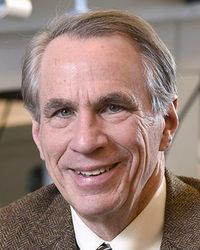
Robert F. Siliciano, MD, PhD
Highlights
Languages
- English
Gender
MaleJohns Hopkins Affiliations:
- Johns Hopkins School of Medicine Faculty
About
Primary Academic Title
Professor of Medicine
Background
Robert Siliciano is a Professor of Medicine at the Johns Hopkins University School of Medicine. He is an immunologist and virologist recognized for his work on the treatment of HIV infection. He is known particularly for identifying and characterizing the latent reservoir for HIV in resting CD4+ T cells. This reservoir is the major barrier to curing HIV infection and the subject of an intense international research effort. Siliciano was born in Rochester, New York and grew up in Elmira, New York. He graduated from Princeton University with a degree in chemistry and then received an MD and a PhD in immunology from the Johns Hopkins University School of Medicine. After a postdoctoral fellowship in immunology at Harvard Medical School, he joined the faculty of the Johns Hopkins University School of Medicine in 1988. He has been a member of the Howard Hughes Medical Institute since 2002 and has been elected to the National Academy of Medicine, the National Academy of Sciences, and the American Academy of Arts and Sciences. For 16 years, he directed the Hopkins MD-PhD Program at Johns Hopkins.
Additional Academic Titles
Joint Appointment in Molecular Biology and Genetics, Professor of Physiology, Pharmacology and Therapeutics
Contact for Research Inquiries
Edward D. Miller Research Building
733 N. Broadway
Baltimore, MD 21205
Phone: (410) 955-2958
Fax: (443) 287-6218
Research Interests
Drug therapy for HIV infection
Lab Website
Siliciano Lab – Johns Hopkins Medicine
- Research in the Robert Siliciano Laboratory focuses on HIV and antiretroviral therapy (ART). ART consists of combinations of three drugs that inhibit specific steps in the virus life cycle. Though linked to reduced morbidity and mortality rates, ART is not curative. Through our research related to latently infected cells, we've shown that eradicating HIV-1 infection with ART alone is impossible due to the latent reservoir for HIV-1 in resting CD4+ T cells. Our laboratory characterized the different forms of HIV-1 that persist in patients on ART. Currently, we are searching for and evaluating drugs that target the latent reservoir. We are also developing assays that can be used to monitor the elimination of this reservoir. We are also interested in the basic pharmacodynamic principles that explain how antiretroviral drugs work. We have recently discovered why certain classes of antiretroviral drugs are so effective at inhibiting viral replication. We are using this discovery along with experimental and computational approaches to develop improved therapies for HIV-1 infection and to understand and prevent drug resistance. Finally, we are studying the immunology of HIV-1 infection, and in particular, the ability of some patients to control the infection without ART.
Research Summary
For the 41 million people infected with HIV-1, the best current hope for avoiding the fatal consequences of the infection lies in treatment antiretroviral therapy (ART), which consists of combinations of drugs that inhibit specific steps in the virus life cycle. The benefits of ART in reducing morbidity and mortality are clear, but ART is not curative. Viremia rebounds if treatment is stopped, usually in about 2 weeks.
In 1995, our laboratory provided the first demonstration that latently infected CD4^^ T cells were present in people with HIV-1 infection^1,2^. We later found that latently infected cells persist indefinitely even with prolonged ART^3-5^. These studies indicated that eradication of HIV-1 infection with ART alone would never be possible. We have shown that the reservoir is not diminished even after >20 years of ART^6^. The latent reservoir for HIV-1 in resting CD4^^ T cells is now widely recognized as the major barrier to curing HIV-1 infection and is the subject of an intense international research effort.
Our laboratory has gone on to characterize the different forms of HIV-1 that persist in people on ART and to explore potential strategies for eradicating the virus. To monitor eradication efforts, we have developed assays such as the quantitative viral outgrowth assay (QVOA) and the intact proviral DNA assay (IPDA)3,7. These assays have become the standard methods for measuring the latent reservoir. Unfortunately, despite an intense effort by many labs, efforts to reduce or eliminate the reservoir have thus far proven unsuccessful. This reflects the difficulties involved in targeting latently infected cells, cells that are essentially invisible to the immune system^8^.
In 2020, we discovered that rebound from a substantial fraction of viruses in the latent reservoir was blocked by the antibody response to the HIV envelope (spike) protein^9^. In untreated infection, the virus rapidly mutates to escape from the antibody response. However, we have shown in many studies that ART blocks viral evolution, and we now believe that that it should be possible to immunize people on ART to produce antibodies to the subset of reservoir viruses that have not already been neutralized. In principle, this should produce a functional cure, allowing people to stop ART without viral rebound. We are now exploring mRNA vaccine strategies to accomplish this goal.
The laboratory is also interested in the basic pharmacodynamic principles that explain how antiretroviral drugs work. In 2008 we uncovered a previously unrecognized form of intermolecular cooperatively that explains why certain classes of antiretroviral drugs are so effective at inhibiting viral replication^10^. We are using this discovery along with experimental and computational approaches to develop improved therapies for HIV-1 infection and to understand and prevent drug resistance.
Selected Publications
- Garcia, M. A., Farrell-Sherman, A., Aydin, B., Zhuo, J., Fray, E. J., Zinsser, A. M., Lai, J., Sowers, K., Li, H., Lopez, B. M., Abeyta-Lopez, A., Chu, T., Lubbeck, D., Chae, M., Bachmann, N., Varriale, J., Westfall, D. H., Hoh, R., Dalhuisen, T., Simonetti, F. R., … Siliciano, J. D. (2026). Inhibitory potential of autologous neutralizing antibodies sets quantitative limits on the rebound-competent HIV-1 reservoir. Proceedings of the National Academy of Sciences of the United States of America, 123(27), e2608337123. https://doi.org/10.1073/pnas.2608337123, PMID: 42391404, PMCID: PMC13342869.
- Bachmann, N., Kim, B., Simonetti, F. R., Kovacs, C. M., Hoh, R., Deeks, S. G., Siliciano, J. D., & Siliciano, R. F. (2026). HIV-1 infection does not confer intrinsic resistance to cell death induced by cytotoxic T lymphocytes. bioRxiv: the preprint server for biology, 2026.03.23.713717. https://doi.org/10.64898/2026.03.23.713717, PMID: 41929103, PMCID: PMC13041980
- Fisher, K.†, Garcia, M. A.†, Frattari, G. S.†, Naasz, C.†, Zhuo, J.†, Rosás-Umbert, M., Dietz, L. L., Juhl, A. K., Falling Iversen, E., Olesen, R., Schleimann, M. H., Pahus, M. H., Johansen, I. S., Henderson, M., Carrere, L., Roseto, I., Gao, C., Yu, X. G., Fray, E. J., Aydin, B., … Søgaard, O. S. (2026). Autologous neutralizing antibodies and polyfunctional T cells contribute to long-term HIV-1 post-intervention control. Nature Immunology, 27(4), 812–826. https://doi.org/10.1038/s41590-026-02448-z, PMID: 41776101, PMCID: PMC13043296
- McMyn, N. F., Varriale, J., Wu, H. W. S., Hariharan, V., Moskovljevic, M., Tan, T. S., Lai, J., Singhal, A., Lynn, K., Mounzer, K., Tebas, P., Montaner, L. J., Hoh, R., Yu, X. G., Lichterfeld, M., Simonetti, F. R., Kovacs, C., Deeks, S. G., Siliciano, J. M., & Siliciano, R. F. (2025). Factors associated with resistance of HIV-1 reservoir viruses to neutralization by autologous IgG antibodies. The Journal of Clinical Investigation, 135(19), e194081. https://doi.org/10.1172/JCI194081,
PMID: 40728901, PMCID: PMC12483561 - McMyn, N. F., Varriale, J., Fray, E. J., Zitzmann, C., MacLeod, H., Lai, J., Singhal, A., Moskovljevic, M., Garcia, M. A., Lopez, B. M., Hariharan, V., Rhodehouse, K., Lynn, K., Tebas, P., Mounzer, K., Montaner, L. J., Benko, E., Kovacs, C., Hoh, R., Simonetti, F. R., … Siliciano, J. M. (2023). The latent reservoir of inducible, infectious HIV-1 does not decrease despite decades of antiretroviral therapy. The Journal of Clinical Investigation, 133(17), e171554. https://doi.org/10.1172/JCI171554, PMID: 37463049, PMCID: PMC10471168
Honors
- Teacher of the Year Award, Johns Hopkins Graduate Student Association, 2007
- Merit Award, National Institutes of Health (NIH), 2007
- AIDS Care Award, International Association of Physicians, 2005
- W. Barry Wood Jr. Award for Outstanding Preclinical Teacher, Johns Hopkins University School of Medicine, 2003
- David Barry DART Achievement Award (HIV DART), National Institute of Allergy and Infectious Diseases (NIAID), 2002
Lectures & Presentations
- Convocation Speaker, Johns Hopkins University School of Medicine, 2015
- Plenary Lecture, 20th Conference on Retroviruses & Opportunistic Infections (CROI), Atlanta, 2013
- Keynote Lecture, Cold Spring Harbor Meeting on Retroviruses, 2011
- Bernard N. Fields Memorial Lecture, Conference on Retroviruses & Opportunistic Infections (CROI), 2009
- Invited Plenary Lecture, 17th World AIDS Conference, Mexico City, Mexico, 2008
- Plenary Lecture, 14th World AIDS Conference, Barcelona, Spain, 2002
Graduate Program Affiliations
Biochemistry, Cellular and Molecular Biology
Cellular and Molecular Medicine
Immunology
Memberships
- Member, American Academy of Arts and Sciences, 2020
- Member, National Academy of Sciences, 2017
- Member, National Academy of Medicine, 2017
- Member, Association of American Physicians, 2016
Professional Activities
Investigator with Howard Hughes Medical Institute (HHMI), 2002
Expertise
Education
- Johns Hopkins University School of Medicine, Ph.D., 1983
- Johns Hopkins University School of Medicine, M.D., 1982